



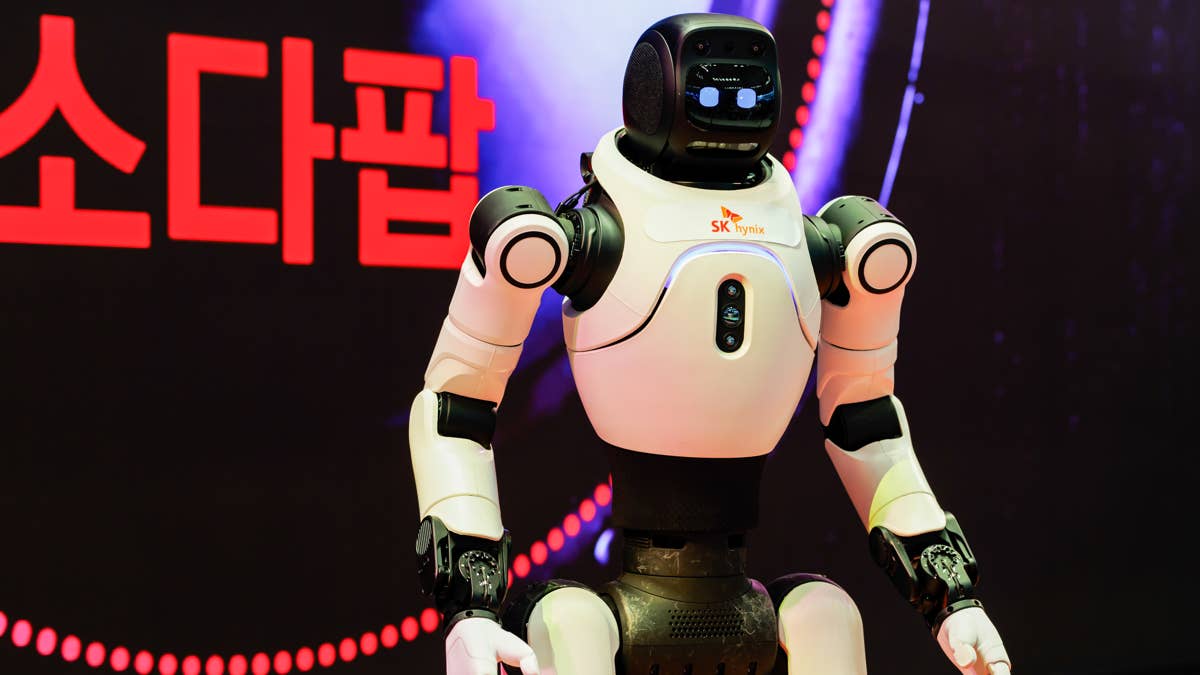


The pitch for humanoid robots usually centers on what they can do, like folding laundry or packing orders in a warehouse. Elon Musk is focused on what they need inside, which pulls SK Hynix Inc. (SKHY) into the robot story.
On Monday, October 26, 2026, Musk wrote on X that robot memory needs “will exceed everything else on Earth.” Wedbush analyst Matt Bryson said wider physical AI adoption raises the odds of a longer memory shortage, according to Seeking Alpha.
SK Hynix backed that thesis on Wednesday, October 28, 2026. It posted a record third-quarter operating profit of 83.3 trillion won (about $62.8 billion), beating analyst estimates.
Also read: Analyst revamps SK Hynix stock price target after blockbuster earnings
On its earnings call, management said tight supply should last through 2030 and named robotics as a longer-term demand driver.
How SK Hynix earned that money is why the robot argument matters. Higher prices, not bigger shipments, drove the quarter. A pricing boom lasts only as long as buyers run short, and robots would lengthen that line.
SK Hynix earned this quarter on price, not volume
DRAM prices rose by a percentage in the high 20s from the second quarter, CFO Kim Woo-hyun said.
DRAM shipments grew only about 10%, he said. NAND shipments slipped, even as NAND prices climbed by a percentage in the mid 20s.
The operating margin hit 80%, according to the company. In my view, pricing power like that exists only when customers have nowhere else to go.
Customers are already rationing. Some are cutting HBM stack heights to stretch supply across more AI chips, HBM sales chief Kim Ki-tae said. Requests run at more than double what SK Hynix can supply, he added.
Robots would fight your phone for the same chips
That rationing has already reached robots. Tesla (TSLA) cut memory on its next robot chips, Musk said on Thursday, October 1, 2026. He called it “the only way to get enough volume for Optimus production.”
I find that cut more revealing than Musk’s latest post. The company most eager to build humanoids is designing around the shortage before mass production.
More SKHY:
- Analyst revamps SK Hynix stock price target after blockbuster earnings
- Samsung, SK Hynix upgrade China plants under U.S. export curbs
- Memory stocks just got a new China wildcard before year-end
Meanwhile, Micron Technology (MU) CEO Sanjay Mehrotra said humanoids could need more than 200 gigabytes of memory each. That estimate assumes builders can get the chips, and Tesla’s cut suggests supply may cap memory per robot before demand does.
The type of memory matters as much as the amount. Musk’s post listed the chip’s memory as LP5, Benzinga reported. That is low-power DRAM, the kind inside phones and laptops.
As a result, robot builders would compete with gadget makers. SK Hynix already expects PC and smartphone shipments to fall as memory costs bite, its CFO said.
Why SK Hynix stock jumped and where analysts stand
SK Hynix is the world’s second-largest memory maker and a key HBM supplier to Nvidia (NVDA), Seeking Alpha reported. Its U.S. shares began trading on the Nasdaq on Friday, July 10, 2026, giving American investors direct access.
The shares rose more than 10% on Wednesday, outpacing a 6.25% gain in the Kospi. The profit beat helped, but cash was the bigger catalyst.
SK Hynix plans to return about 100 trillion won ($75 billion) to shareholders in 2026. “We believe our share price today is undervalued, not adequately reflecting our earnings and cash flow,” the CFO said, answering Meritz Securities analyst Sunwoo Kim.
The valuation backs him up. SKHY traded at about 4 times forward earnings before Wednesday’s jump, according to StockAnalysis, a price that treats today’s profits as a peak.
Its 52-week range runs from $124.80 to $199.87. It covers only trading since July.
Wall Street is far more upbeat. The 15 analysts tracked by StockAnalysis rate SKHY a consensus Strong Buy, with an average price target of $243.43. The latest calls all predate Wednesday’s report:
- Buy, $200 target: RBC Capital’s Srini Pajjuri, Monday, October 26, 2026.
- Buy, $300 target: Barclays’ Simon Coles, Tuesday, October 6, 2026.
- Buy, $268 target, up from $250: Bank of America’s Simon Woo, Monday, September 14, 2026.
The memory cycle is turning into a waiting list
Memory booms usually end in a glut once makers overbuild. Woo raised that fear on the call, and the CFO said new clean rooms will open in phases.
Yet the bigger change is contractual. Long-term agreements with 14 customers now cover more than half of SK Hynix’s capacity for 2027 and 2028, the CFO said. CEO Kwak Noh-Jung added that DRAM and HBM volumes are effectively sold out through 2029.
Robots would not create that queue. They would join it, behind cloud giants that locked in supply first. If humanoids scale before new fabs arrive, the real limit on the robot economy may be a memory maker’s allocation list, not motors or software.