

Despite surprise top- and bottom-line beats, Tesla shares took a bit of a haircut this week immediately following the release of its third-quarter results. Investors who dug beneath the surface seemingly weren’t that impressed with the 48 cents per share in profit (vs. 43 cents exp.) and $28.05 billion (vs. $27.9 billion exp.) that the electric vehicle maker reported for the period.
That may be because the further you dig, you find that revenue was slightly down year over year, as core automotive revenue declined 3% and energy revenue fell 16%. Tesla blamed the decrease in automotive revenue on lower average sale prices for its cars and trouble securing battery supplies to make enough vehicles to fulfill backlog orders.
Also read: Elon Musk wants every American kid to own a SpaceX share
But despite the mixed results, analysts at Morgan Stanley say they are incrementally more constructive on Tesla thanks to the bigger picture: Robotaxi scaling and Full Self-Driving (Supervised) adoption.
Tesla Robotaxi strategy is working, Morgan Stanley says
Earlier this year, CEO Elon Musk announced that the company was raising its capital expenditure guidance for 2026 to $25 billion in order to scale up Tesla’s Robotaxi and humanoid robot operations (however, Tesla did lower its Capex guidance back down to more than $20 billion in the quarter, so it is unclear how that will affect expansion plans).
About nine months later, Morgan Stanley analyst Andrew Percoco is starting to see the results.
“Tesla’s results reinforce our view that the company is making tangible progress toward commercializing autonomy and robotics, with encouraging proof points around FSD adoption and Robotaxi fleet growth,” Percoco said in a note this week that was viewed by TheStreet.
More Elon Musk:
- SpaceX CEO Elon Musk has 7 words for Delta Airlines after snub
- Elon Musk just handed Nvidia investors another big win
- Billionaire investor makes stunning $15 trillion Musk call
The analyst says Robotaxi is at an inflection point as Cybercab deployment has increased ten-fold in Austin with plans to expand to four new cities soon.
“We estimate that weekly autonomous miles driven have increased to greater than 558k/week, from greater than 44k in early July, with growth accelerating to nearly 30% week over week over the past three weeks,” Percoco said. “We view this acceleration as an encouraging indication that Tesla is beginning to move beyond the initial software validation phase toward more meaningful commercial scaling.”
Tesla buyers are also buying into FSD
Tesla has said for years that it considers itself a tech company, not a car company (even though 80% of the revenue comes from car sales). So for some investors, falling car revenue isn’t as important as adoption rates for Tesla’s FSD subscription service.
According to Tesla, more than 75% of its North American deliveries included a paid FSD subscription in Q3, up from 55% in Q2. Total paid FSD customers increased to 1.7 million globally from 1.5 million the previous quarter.
Related: Sam Altman praises the Tesla Roadster he gave up on
“It is clear that FSD is increasingly driving vehicle purchase decisions while improvements in the v15 software stack and regulatory approvals in Europe could support broader adoption,” Percoco said. “We view accelerating FSD adoption as supportive of our long-term Network Services thesis, where we assume FSD penetration reaches 40% of the cumulative fleet by 2030.”
Analysts less convinced about Optimus humanoid robot
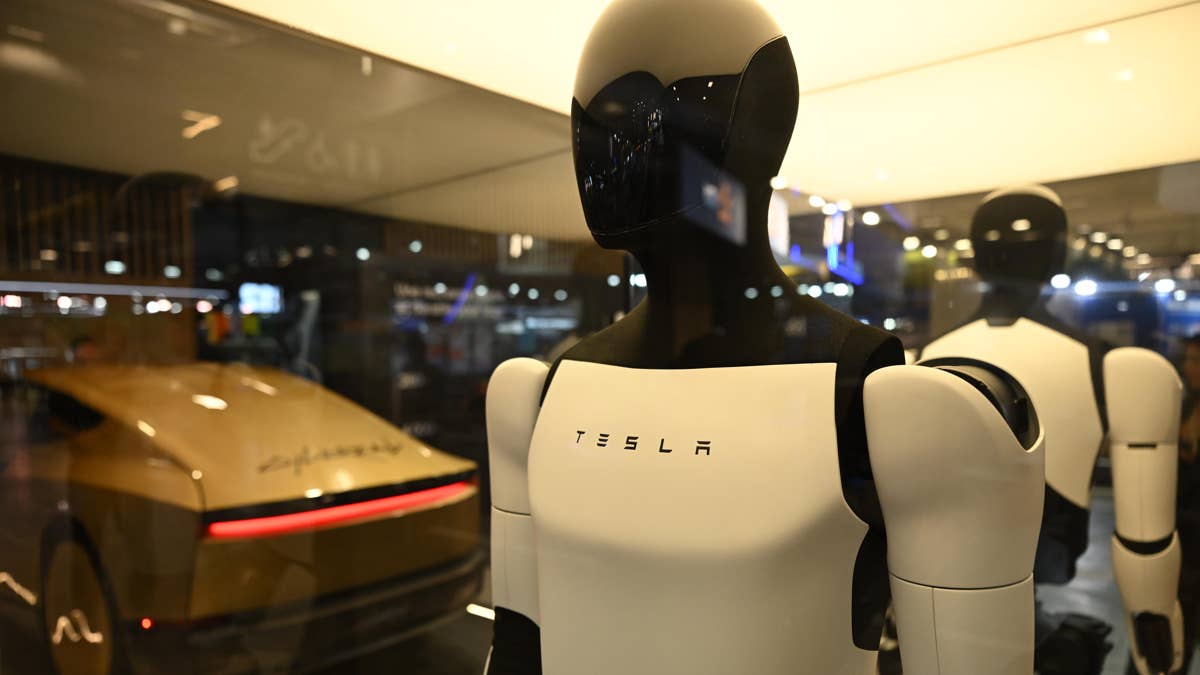
When Elon Musk sold the Capex plan to investors, he said that the money would be needed for Robotaxi expansion and to fund the ramp for the Optimus humanoid robot. The company eventually plans to produce 1 million Optimus robots annually, but to do that they need to convert production capacity from vehicles to robots.
Musk predicted that 2026 would be a major inflection point for production, but now even the bulls at Morgan Stanley have to revise the timeline, “recalibrating expectations for commercialization toward late 2027.”
“Tesla has begun early production on its high-volume Optimus line in Fremont, with the majority of equipment for a greater than 1 million unit annual capacity line already installed,” Percoco said. “However, Musk cautioned that reaching an annualized production rate of greater than 20k units per week will likely take at least another year, potentially longer.”
Musk has a habit of promising huge leaps in condensed timelines that ultimately need to be pushed back. He’s doing the same thing with the Optimus rollout, but Morgan Stanley seems willing to still take him at his word that 2027 will be the inflection point for Optimus. Time will tell the truth.
Morgan Stanley maintained an equal-weight rating and a $410 price target on the shares.