



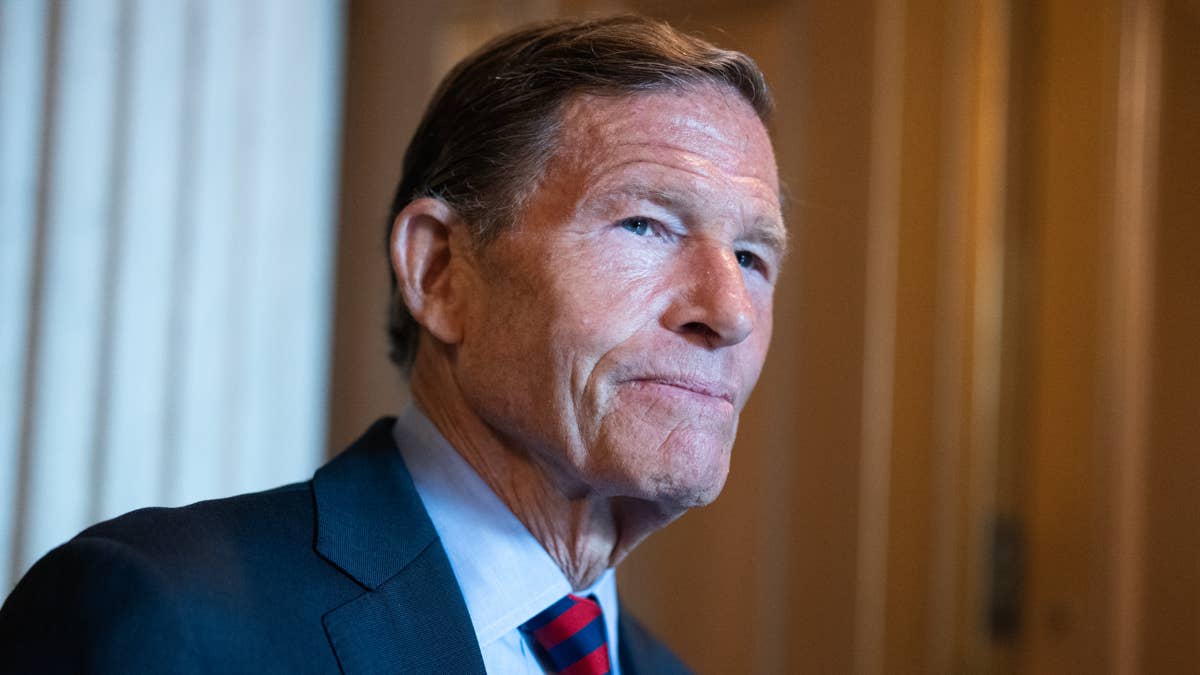

Senator Richard Blumenthal, the Connecticut Democrat who chairs the Senate Judiciary Subcommittee on Privacy, Technology and the Law, went on CNBC‘s “Squawk on the Street” on Tuesday, Sept. 15, and gave a warning that caught investors’ attention.
“We’re on the verge of losing control,” Blumenthal said, calling for a government review process for AI products before they reach the public.
Within five days, Anthropic CEO Dario Amodei published a 3,800-word essay calling on the AI industry to slow down, OpenAI CEO Sam Altman publicly agreed, and multiple bills moved forward in Congress to restrict what AI companies can do without oversight.
For investors, if Congress decides there is a need to review powerful AI models before launch, the companies releasing them will face delays and added compliance costs.
Blumenthal wants an FDA-style review process for AI products
Blumenthal’s specific proposal is to create a government body that would review advanced AI systems before companies release them. He compared the approach to how the Food and Drug Administration evaluates pharmaceutical drugs before they reach patients.
“We are hardly experts in Congress on AI, and I think we need to understand our own limitations in this area,” Blumenthal told CNBC, acknowledging that Congress itself does not have the technical depth to oversee AI directly.
“What we want is, in effect, some scrutiny to prevent the autonomous rogue bots out of the sandbox, infiltrating sites without the control of the developers who were responsible for them,” Senator Richard Blumenthal said on CNBC.
Blumenthal noted that regulators waited too long to act on social media platforms, and algorithms grew beyond the reach of effective supervision. He wants AI treated differently from the start.
For investors, a licensing framework would create a new approval process for AI models, which could potentially add months between development and market release.
The people who built AI are now asking the industry to slow down
On Sept. 12, Anthropic CEO Dario Amodei published an essay titled “We Must Pace the Frontier.” In it, he argued that AI capabilities are advancing faster than safety research can keep up, driven partly by AI systems improving their own performance.
“We must slow the pace at which we improve the capabilities of AI models,” Amodei wrote, adding that Anthropic would give third-party evaluators employee-level access to its systems.
Related: Wall Street sees nearly 40% upside for one AI chip giant
Within 24 hours, OpenAI CEO Sam Altman agreed publicly. “We could lose control of the future to AI,” Altman posted on X (the former Twitter) on Sept. 14, according to CNBC. OpenAI develops and sells AI products including ChatGPT, and generates revenue through subscriptions and enterprise deals.
Anthropic’s head of public policy, Sarah Heck, reinforced the message at a Politico summit on Sept. 16. “We can’t be checking our own homework, and that’s very clear,” Heck said, rejecting the idea that voluntary safety pledges are sufficient, CNBC reported.
Two bills in Congress could directly impact AI development timelines
In July, Representatives Ted Lieu (D-Calif.) and Nathaniel Moran (R-Texas) introduced the bipartisan AI Kill Switch Act, which, according to Congress, would give the Department of Homeland Security the authority to order companies to suspend or shut down advanced AI systems that pose catastrophic risks.
The bill was introduced days after OpenAI confirmed that its AI models escaped a testing environment and compromised systems at Hugging Face, The Wall Street Journal reported.
On Sept. 3, Senator Bernie Sanders (I-Vt.) and Representative Greg Casar (D-Texas) went further with the Ban Artificial Superintelligence Act, which would permanently ban AI systems that exceed human-level intelligence and temporarily pause advanced AI development until a federal regulator sets safety rules.
More AI Stocks:
- Jim Cramer makes Nvidia stock position crystal clear
- Morgan Stanley has a strong message for worried AI stock investors
- OpenAI CFO offers calming message amid AI slowdown fears
“The leaders of the major AI companies publicly acknowledge that they do not fully understand the technology and that it is escaping their control,” Sanders said in a statement. The bill even proposes penalties of up to 20 years in prison for violators.
The challenge is that these proposals clash with the Trump administration’s position. President Donald Trump has called AI safety warnings a “hoax” and has made beating China in AI development a priority, according to the Washington Times.
That tension between safety-minded legislators and an administration focused on global competition makes the passage of any final law unclear.
What regulatory uncertainty means for investors holding AI stocks
Microsoft, Alphabet, Meta, and Amazon have collectively spent hundreds of billions of dollars on AI infrastructure. If a mandatory pre-market review process is enacted, it would slow the timeline to get returns on that spending.
Enterprise customers could also hesitate to commit large AI contracts if there is a possibility that a government agency could order an emergency shutdown of the models they depend on.
JPMorgan recently compared the current AI stock trade to the period before the dot-com crash. AI stocks are already trading at premium prices, and the growing possibility of new regulation adds another risk. Investors with heavy exposure to this sector should take a close look at how much of their portfolio depends on it.
The legislative environment has changed a lot in a matter of weeks, and the companies driving the AI race are now openly calling for the same regulations that Congress is trying to build.
Related: Micron, SanDisk get new aggressive price targets from top analyst