





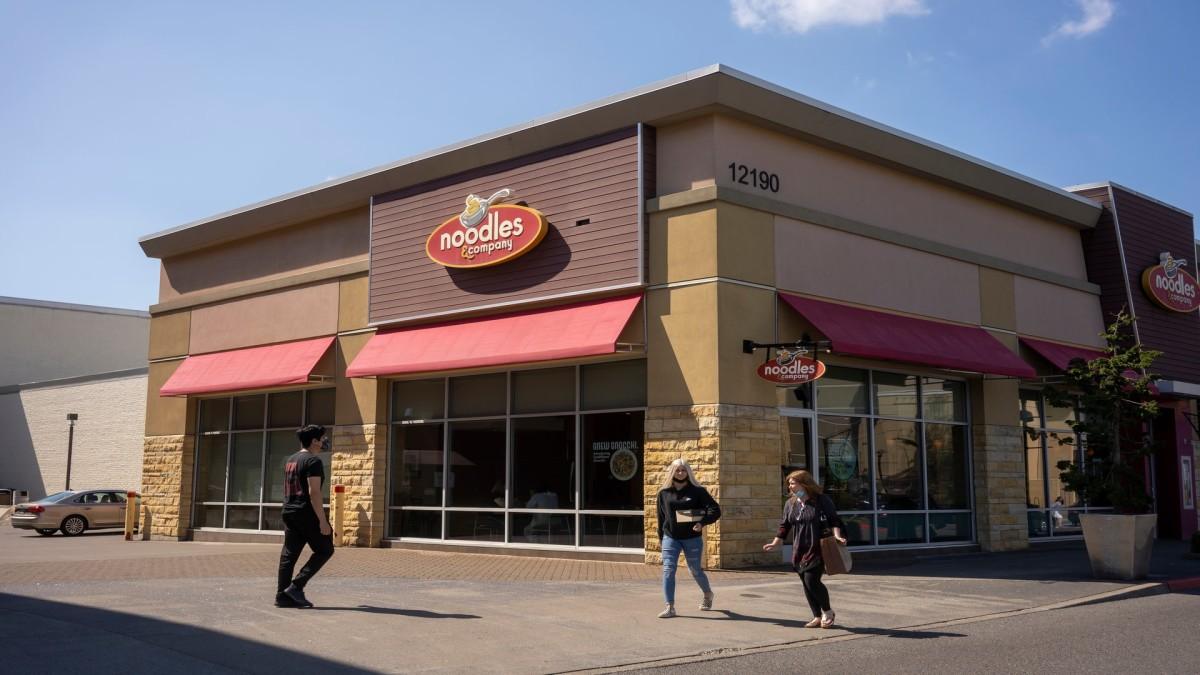

Simple bowls of noodles and sauces led a fast-casual restaurant chain to become a beloved brand for decades and many families’ go-to post-mall shopping meal.
Now, however, the chain is joining a growing list of competitors facing operational and financial pressures in an increasingly challenging market.
Founded in 1995 in Denver, Colorado, Noodles & Company quickly gained popularity with its signature noodle dishes. The company’s early success allowed it to expand nationwide and go public in 2013.
Yet, even with a strong start, the brand was not immune to the lingering effects of the Covid pandemic, which contributed to reduced consumer spending and rising operational costs.
In response, Noodles & Company disclosed in September 2025 that it was exploring “strategic alternatives” to maximize shareholder value, including refinancing, refranchising, or potentially selling the business.
“We believe now is the appropriate time to consider strategic options for our brand that could allow us to more effectively maximize value for our shareholders,” said Noodles & Company CEO Joe Christina in a press release.
Adding to its growing challenges, the company received at least two delisting warnings from Nasdaq, first in December 2024 and again in June 2025, after failing to maintain the minimum share price of $1 for more than 30 consecutive trading days.
Now, Noodles & Company has revealed a major update on the future of its business.
Noodles & Company reveals more restaurant closures in 2026
Following a “thoughtful” review of the business, Noodles & Company (NDLS) revealed plans to close 30 to 35 restaurants in 2026, continuing a trend of closures that has reduced its national footprint over recent years.
As of the end of 2025, the chain operated 423 restaurants, comprising 340 company-owned and 83 franchise locations, according to its preliminary results for the fourth quarter of 2025.
“We are continuing to close underperforming restaurants and benefiting from the transfer of approximately a third of their sales to nearby profitable locations,” said Noodles & Company’s CEO Joe Christina in the company’s third-quarter of 2025 earnings results. “All of this is driving margin and Adjusted EBITDA improvement, guest enthusiasm and strengthening our relevance.”
This strategy appears to be working. Noodles & Company reported a 32.7% increase in adjusted EBITDA, reaching $6.5 million in the third quarter of 2025, up from $4.9 million the previous year.
Meanwhile, its stock surged 14.6% at market close on January 12, representing a more than 21% year-to-date gain, according to Yahoo Finance.
Noodles & Company’s strategy to revive growth
To reignite growth, Noodles & Company has leaned on menu innovation and value-focused initiatives. In early 2025, the chain revamped its menu, introducing new dishes and enhancing fan favorites while stepping up marketing efforts nationwide.
More Restaurant Closures:
- Formerly bankrupt restaurant chain announces major turnaround update
- 53-year-old restaurant chain is quietly closing locations nationwide
- 21-year-old fast-food chain is closing 20 restaurants amid comeback
The changes initially resonated well with consumers. In the first quarter of 2025, total revenues rose 2% year over year, with same-store sales increasing 4.4%.
However, by the second quarter of the same fiscal year, revenue growth slowed to 0.7%, as shifting consumer habits and a value-conscious market amid economic uncertainty took effect.
“Our sales and traffic moderated after the initial successful rollout of our new menu due to the strong value-conscious climate as well as slower guest adoption of the upgrades made to some of our historic menu items,” said former Noodles & Company CEO Drew Madsen in a press release. “We have been moving decisively to address these factors, particularly around guest value perception.”
Noodles & Company responded by launching Delicious Duos in July 2025, following a survey to gather consumer feedback. This effort contributed to a 4.5% comparable sales increase in August, and by the third quarter of 2025, comparable sales rose 4% system-wide, despite a 0.5% decline in total revenue.
Noodles & Company restaurant closures
Closures have become an ongoing reality for Noodles & Company, as it works to strengthen its bottom line.
Noodles & Company closure timeline
- 2024: Closed 13 company-owned restaurants and seven franchise locations (Source:Noodles & Company Investor Relations)
- 2025: Closed 33 company-owned restaurants and nine franchise locations during 2025 (Source:Noodles & Company Investor Relations)
- 2026: Plans to close 30 to 35 company-owned restaurants by the end of 2026 (Source:Noodles & Company Investor Relations)
Broader restaurant industry struggles
Noodles & Company’s struggles reflect broader trends in the restaurant industry, where rising costs and shifting consumer habits have led to thousands of closures across the sector. Even long-standing chains are suffering the same fate.
Restaurant chains that have recently closed locations
- Red Lobster: Filed for Chapter 11 bankruptcy in 2024 and shuttered hundreds of locations (Source:The Street)
- Applebee’s: Expected to close 20 to 35 restaurants in 2024 (Source:Restaurant Dive)
- Outback Steakhouse: Shuttered 21 restaurants as of November 2025 (Source:CNN)
- Romano’s Macaroni Grill: Recently closed multiple locations, leaving just nine restaurants nationwide (Source:The Street)
Inflation has played a key role in restuarant closures. Prices for food away from home rose 3.7% in the 12 months ending September 2025, according to recent U.S. Bureau of Labor Statistics data.
In addition, over the past five years, food and labor costs for the average restaurant have each increased by around 35%, according to the National Restaurant Association. To offset those increases, menu prices climbed an average of 31% between February 2020 and April 2025, based on U.S. Bureau of Labor Statistics data.
As prices rise, customer traffic has declined 1% across the food service industry during the quarter ending June 2025, according to Circana.
“This poses a significant challenge for restaurants, as home-cooked meals directly substitute demand for dining establishments, translating to reduced revenues and declines in customer traffic as demand shifts to grocery stores,” said Coresight Research analyst Sujeet Naik.
To combat rising costs and softening demand, many restaurants are turning to menu innovation, modernization, and redefined value propositions.
“In response to the decreasing food dollar and the empowered customer, restaurants are turning to innovative business and operating models to grab a greater share of the market,” said KPMG Restaurant Segment Leader Paul Fultz and Strategy Leader of Consumer Markets Joel Rampoldt in a study.
Related: Iconic burger and bar chain owner faces collapse, Chapter 11